In a scene that felt straight out of Ex Machina, Chinese EV maker Xpeng stunned audiences by “unzipping” its new humanoid robot to prove there wasn’t a person inside — after its ultra-realistic movements sparked disbelief online.
The company’s founder, He Xiaopeng, personally demonstrated the test, having a colleague open the robot’s back to reveal mechanical parts and cooling fans — clear proof it was all machine. The video quickly went viral on Chinese social media, with hashtags like #XpengRobotUndressedTestFootage and #WhatXpengRobotLooksLikeWithoutItsSkin topping Douyin’s trending list.
According to He, the robotics team was “too excited to sleep” after the debut, as footage of their creation — a humanoid named IRON — spread rapidly across the internet, drawing fascination and skepticism in equal measure.
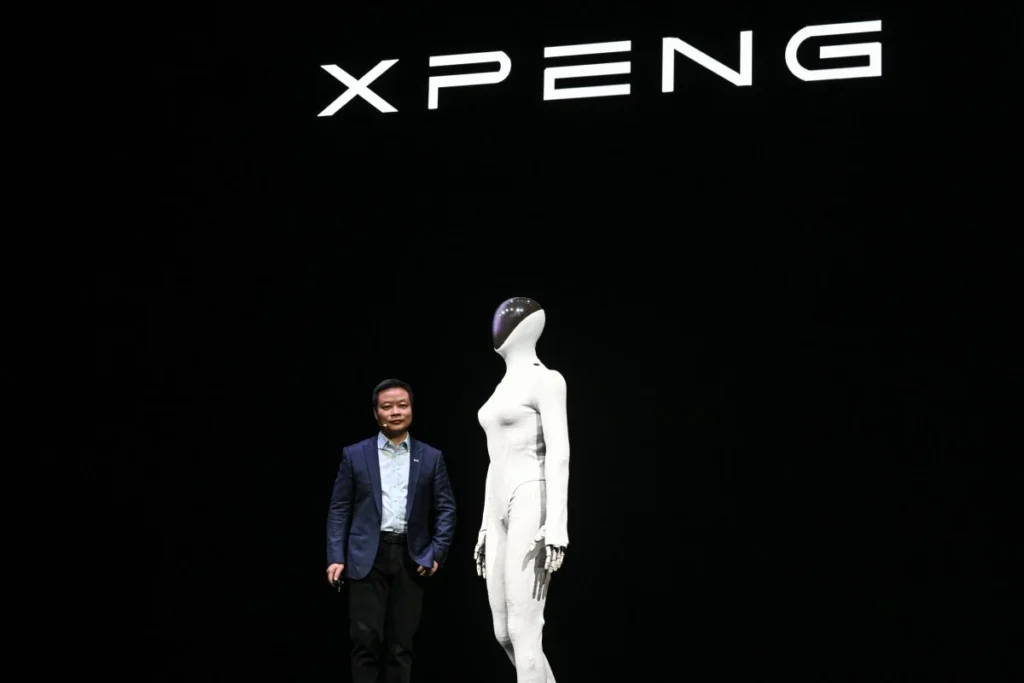
Powered by Xpeng’s Vision-Language-Action (VLA) 2.0 AI model, IRON processes visual data directly to make decisions, enabling incredibly fluid, humanlike motion. The robot is equipped with 82 degrees of freedom, including 22 in each hand, and moves with a flexible spine, bionic muscles, and soft synthetic skin — allowing it to strut, dance, and gesture almost naturally.
To drive these lifelike movements, IRON runs on three custom AI chips capable of a combined 2,250 trillion operations per second (TOPS), placing it among the most powerful humanoid robots in existence.
Xpeng describes IRON as “born from within,” designed to mirror human anatomy from the inside out. The company has even built both broad male and slimmer female versions, the latter being trickier to engineer due to tighter internal space.
He Xiaopeng said the goal is to create robots that feel familiar and approachable:
“The next generation has flexible bones, solid bionic muscles, and soft skin. In the future, robots will be life partners and colleagues. Just like buying a car, people will be able to choose the appearance and style they want.”
Notably, IRON is also the first humanoid robot powered by a solid-state battery, a safer alternative to traditional lithium-ion cells.
While the company doesn’t plan to send IRON into homes just yet, Xpeng expects the robot to appear in commercial environments — such as stores, offices, and showrooms — starting in 2026.
Beyond robotics, the project is part of Xpeng’s larger push into “physical AI,” combining robotics, AI, and autonomous vehicle technology. The firm even recently teased a flying car prototype, underscoring its ambitions to redefine mobility and automation.
The unveiling of IRON also signals China’s accelerating progress in humanoid robotics. Xpeng already has industrial clients lined up — including Baosteel, the nation’s largest steelmaker — and industry data shows China’s robotics sector grew nearly 30% in the first three quarters of the year.